Congress is currently considering the Bipartisan American Affordability and Jobs Act (BAAJA). BAAJA would profoundly reshape how the federal government regulates infrastructure, especially energy infrastructure such as power lines and pipelines. The Senate passed BAAJA on November 19. The House will likely vote on it soon.
BAAJA proponents often cite greenhouse gas emission reductions as a reason why Democrats should vote for the bill. Ezra Klein, for example, structured his November 15 op-ed substantially around climate themes.
Modeling by Greenline Insights and the Center for Climate and Energy Solutions, Resources for the Future, and Rhodium Group suggests that BAAJA could reduce greenhouse gas emissions by on the order of 100 million metric tons per year, or about 2% of 2025 United States greenhouse gas emissions.
Here, I explain why I do not believe BAAJA would reduce emissions.
BAAJA is bigger than electricity
The Greenline/C2ES and RFF studies consider the electricity sector only. The Rhodium study focuses substantially on electricity, but also considers natural gas infrastructure.
Focusing narrowly on the electricity sector misses two major sources of emissions that BAAJA would likely accelerate: Methane1 emissions from oil and gas production and carbon dioxide emissions from induced demand for fossil fuels (such as increased natural gas use by price-sensitive industrial processes, or new natural gas use in regions that today are pipeline-constrained). I estimate that through these non-electricity effects, BAAJA would likely add on the order of 100 million metric tons of carbon-dioxide-equivalent emissions per year2.
Induced electricity demand matters
Within the electricity sector, modeling that suggests BAAJA would reduce emissions is generally contingent on the assumption that electricity demand would be the same with and without BAAJA3. I do not believe this assumption is plausible. By accelerating buildout of power lines and pipelines, BAAJA would make it easier for data centers and other large loads to connect to both power grids and the natural gas pipeline networks that supply behind-the-meter generators. If BAAJA lowered wholesale electricity prices, as some modeling suggests it might, it would also induce electricity demand from large, price-sensitive loads, such as Bitcoin mining.
If a world with BAAJA has higher electricity demand than a world without BAAJA, then BAAJA causes additional electricity-sector emissions unless clean sources supply at least 100% of the induced electricity demand. Electricity demand growth can in principle reduce emissions in other sectors if it comes from electrification–replacing fossil-fueled machines by electric alternatives, a major theme of my research–but BAAJA is not an electrification bill.
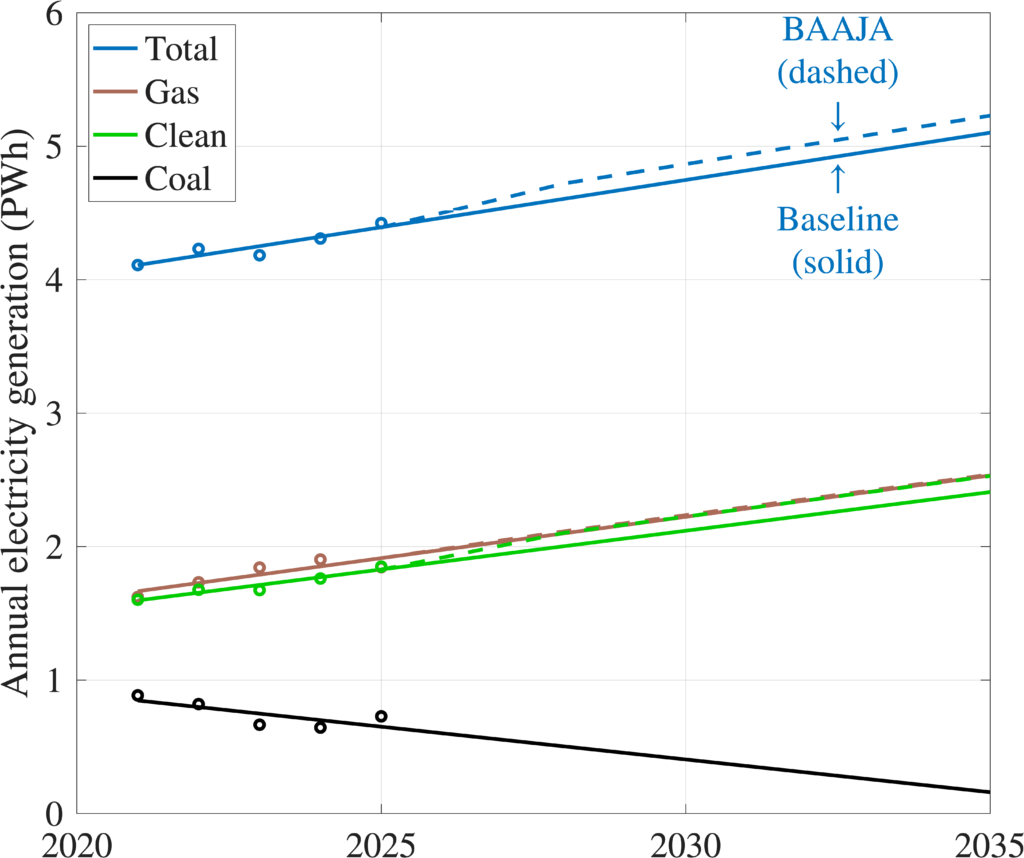
The plot above shows electricity sector trajectories through 2035. Blue, brown, green, and black indicate total electricity generation and generation from natural gas, clean (non-fossil) sources, and coal, respectively. The solid lines are fit to historical data from 2021-25 (circles) and extrapolated through 2035, forming the “without BAAJA” baseline. Dashed lines indicate the “with BAAJA” scenario.
In the “without BAAJA” baseline (solid lines), total electricity generation grows through 2035. Generation from coal declines. Generation from natural gas and clean sources both grow, meeting demand growth and filling in for coal’s decline.
These trends persist in the “with BAAJA” scenario (dashed lines): Total generation grows; coal declines4; generation from natural gas and clean sources both grow. In this illustration, I model BAAJA as having two effects: Increasing demand relative to the “without BAAJA” baseline by up to 2.5% (dashed blue line rising above the solid blue line) and increasing clean generation relative to the “without BAAJA” baseline by up to 5% (dashed green line rising above the solid green line)5.
This illustration shows an optimistic scenario wherein clean generation makes up 90% of the additional electricity demand through 2035 due to BAAJA. Because natural gas makes up the remaining 10%, however, electricity-sector emissions end up slightly higher in a world with BAAJA than in a world without BAAJA. The figure below shows the electricity-sector emission trajectories, in units of billion metric tons per year.
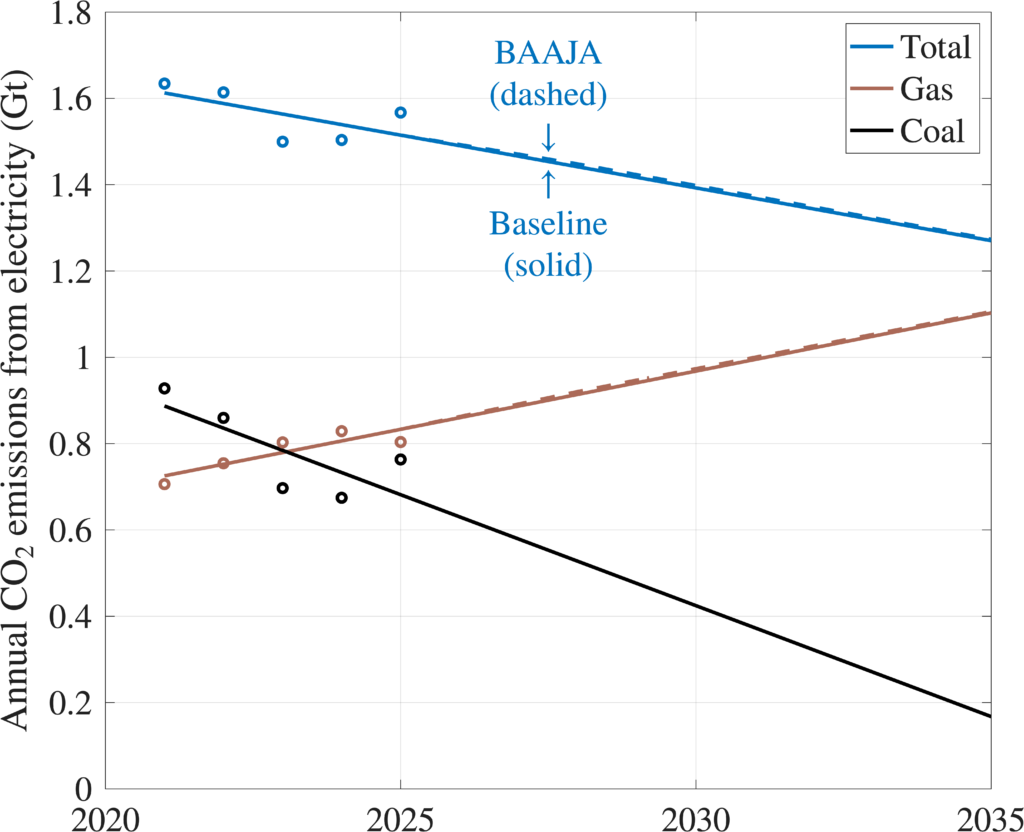
Even in this optimistic scenario, BAAJA does not reduce electricity-sector emissions. To reduce economy-wide emissions, BAAJA would not only have to reduce electricity-sector emissions, but reduce them substantially enough to outweigh BAAJA’s emission increases in other sectors.
- Methane is the main constituent of natural gas and a potent, fast-acting greenhouse gas. Human activities that emit methane have caused about two-thirds as much global warming as all carbon dioxide emissions since the Industrial Revolution. In a 2025 Energy Policy paper, I estimated that methane emissions from oil and gas infrastructure largely erode the perceived post-2005 decline in United States greenhouse gas emissions. ↩︎
- These estimates use the 100-year global warming potential of methane, which is about 2.8 times lower than the 20-year global warming potential. The estimates do not include any emissions associated with fossil fuel exports. ↩︎
- For example, the annual total generation levels (bar heights) in Figure 3 of the RFF study are identical between the baseline and central case in all years. ↩︎
- Electricity-sector modeling suggests BAAJA would have little to no impact on accelerating coal decline. Figure 3 of the RFF study, for example, shows essentially identical coal generation levels (black bars) between the baseline and central case in 2035 and 2041. ↩︎
- A 2.5% increase in electricity demand could come, for example, from a 10% increase in industrial demand, which made up 26% of total electricity demand in 2025. A 5% increase in clean electricity generation could come, for example, from a 12% increase in combined wind and solar generation, which made up 42% of clean generation in 2025. ↩︎