Yesterday, Alex Trembath, Executive Director of the Breakthrough Institute, criticized my modeling in a Substack post titled “On Anti-BAAJA Bullshit.” BAAJA is the draft federal permitting bill scheduled for a Senate vote tomorrow (Monday, November 9). Interested readers can see this article for background on the Breakthrough Institute.
In his post, Mr. Trembath wrote the following in reference to a post on X by Representative Jared Huffman (D-CA), ranking member of the House Committee on Natural Resources, that cited my modeling.
“Huffman cites a single academic paper with a bizarre methodology to justify his claim that BAAJA will increase emissions. That paper models real-world 2025 emissions against a counterfactual 2025 in which BAAJA had somehow been passed previously, and in doing so assumes, rather than estimating or concluding, that US oil and gas production will rise, pushing emissions up in absolute terms.”
Here, I address Mr. Trembath’s criticisms and discuss the differences between my modeling and think-tank modeling that suggests BAAJA would reduce emissions.
Why the 2025 counterfactual?
My central modeling compares 2025 as it was to a counterfactual where BAAJA had been in full effect in 2025. Mr. Trembath is correct that this approach is unconventional.
To address this feedback, I added a sensitivity study (Section 6.3 in the updated version) that looks ahead over a ten-year forecast horizon. In this sensitivity study, I form an example baseline by fitting linear models to energy data from 2015 to 2025 and extrapolating them through 2035. I assume that BAAJA’s effects ramp up over three years, then remain at full strength through 2035. I find that the modeling conclusions in this forward-looking approach are directionally consistent with the target-year approach I use in the central modeling. Estimated energy flows—the main determinants of outputs such as revenues, jobs, greenhouse gas emissions, and mortality attributable to air pollution—agree between the two approaches within 8% to 20% error (15% on average). These results suggest that the target-year approach and the forward-looking approach provide similar actionable information to decision-makers.
I retained the 2025 counterfactual in the central modeling for two main reasons. First, defining a forward-looking baseline requires making many subjective choices about how future energy systems may evolve. Each of these subjective choices introduces uncertainty into the modeling, presents opportunities for bad-faith modelers to make hidden assumptions that align modeling conclusions with their ideological or political goals, and makes it harder for other people to audit modeling assumptions and reproduce or falsify results. I believe that my choice of a 2025 baseline improved transparency while facilitating uncertainty quantification and sensitivity analysis. I wrote more on transparency and trust in energy modeling yesterday, including the standards to which I held my BAAJA modeling.
Second, in the field of sequential decision-making under uncertainty, where much of my research focuses, understanding realistic near-term consequences is generally more important than exploring far-future possibilities. This intuition suggests that to support good decision-making today, it is more important to characterize BAAJA’s potential impacts this decade, when United States energy systems are unlikely to diverge substantially from their 2025 state, than to speculate about energy systems in 2040.
Why assume fossil fuel production increases?
Mr. Trembath is correct that I model BAAJA as increasing United States fossil fuel production. I model a 5% increase on average relative to a baseline without BAAJA. For context, United States fossil fuel production increased by 28% from 2015 to 2025, as the figure below shows. Back in 2015, when evaluating the potential impacts of lifting longstanding restrictions on oil exports, modelers mostly missed this production boom.
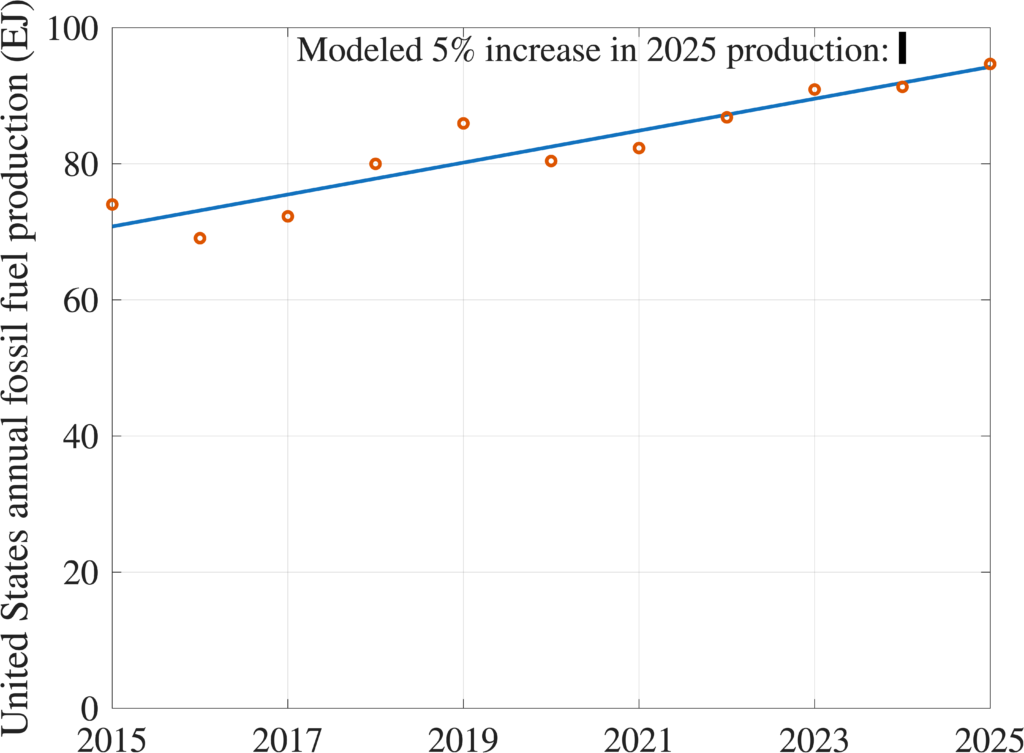
To investigate how BAAJA’s impact on fossil fuel production influences model outputs, I added a sensitivity study (Section 6.2 in the updated version) that shifts the distribution of potential production increases. With mean production increases of 3% and 7% and all other model settings held constant, the probabilities that BAAJA increases domestic greenhouse gas emissions are 74.4% and 93.0%, respectively. In the central case of a 5% mean production increase, this probability is 85.7%. In the extreme case where it is impossible for BAAJA to increase fossil fuel production, the probability that BAAJA increases emission is 51.6%. These results suggest that BAAJA’s influence on fossil fuel production is indeed an important consideration, but that BAAJA is about as likely as not to increase emissions even if it has no possible influence on fossil fuel production.
Interestingly, Mr. Trembath does not criticize the 5% average increase that I model, only that my modeling “assumes, rather than estimating or concluding,” that fossil fuel production increases. This mirrors criticisms of my modeling by Richard Meyer, Vice President of Energy Markets, Analysis, and Standards at the American Gas Association. Mr. Meyer also took issue not with the modeled 5% average increase in fossil fuel production, but with the fact that I assumed this increase rather than deriving it from other assumptions made upstream in the modeling process.
Mr. Trembath or Mr. Meyer can correct me if I’m wrong, but I view this side-stepping of the 5% number itself as implicit agreement that this number is plausible. It may well be an underestimate. I would be surprised if the American fossil fuel majors have not done extensive internal modeling of BAAJA’s potential impacts on their domestic production. I imagine those internal modeling results, if they exist, would add useful information to this discussion.
In my opinion, understanding a realistic range of BAAJA’s potential impacts on fossil fuel production is more important than debating whether to assume or derive that range. As I wrote yesterday, all energy modeling is based on assumptions. I could just as well have made assumptions about upstream variables, such as costs or constraints associated with drilling wells or expanding pipelines, and derived a production change. I do not believe this would have significantly improved rigor, as BAAJA’s potential impacts on those costs and constraints are also uncertain.
As an example of upstream vs. downstream assumptions, I refer to the Resources for the Future BAAJA modeling, which I view as the think-tank study that does the best at transparently disclosing its assumptions. I only single out this study because the other think-tank studies do not disclose their assumptions to a degree that third parties can audit. Rather than making a downstream assumption about BAAJA’s potential to accelerate buildout of electricity transmission, the RFF modelers made a range of upstream assumptions, such as removing constraints on wind capacity additions beyond 2030 and decreasing the costs of interconnection and spur lines on federal lands by 50%. Why 2030? Why 50%? Because the modelers viewed these as reasonable assumptions. Downstream estimates, such as the rates of transmission buildout and clean electricity growth, are contingent on these assumptions.
Other differences from think-tank modeling
Two other broad differences may explain why my emission estimates diverge from estimates by Greenline Insights/Center for Climate and Energy Solutions, Resources for the Future, the Columbia Center on Global Energy Policy, and Rhodium Group.
- Scope: The Greenline/CCES and RFF studies consider only the electricity sector (18% of United States final energy). It is important not to conflate electricity-sector emission reductions with economy-wide emission reductions. The Rhodium study considers “linear infrastructure like transmission lines and gas pipelines,” but does not, as far as I can tell, consider potential impacts on fossil fuel production or most direct uses. The CGEP study has the broadest scope but reports little quantitative modeling. My scope covers 95% of United States primary energy.
- Energy demand: As far as I can tell, none of the think tanks include in their emission estimates the possibility that BAAJA might increase energy demand, for example, by alleviating interconnection or resource-adequacy constraints that would otherwise limit access to electricity grids or natural gas pipeline networks for data centers or other large loads. Similarly, as far as I can tell, none of the think tanks include in their emission estimates BAAJA’s potential to increase domestic fossil fuel direct use, for example, by expanding natural gas pipelines to transmission-constrained regions such as the Northeast, or through price effects.
