On September 30, the Senate released a draft of the Bipartisan American Affordability and Jobs Act of 2026 (BAAJA), a 417-page beast of a highly technical bill. BAAJA would overhaul, in deep and complex ways, the federal policies and procedures that regulate infrastructure construction and operation.
I don’t think anyone fully understands BAAJA’s potential benefits and risks yet. I certainly don’t! The text is hard to parse: It’s long, dry, technical, referential of other bodies of law, and in places ambiguous. Experts disagree not only on how to read portions of the text, but on what those different readings might imply for infrastructure evolution. Beyond debates over the text itself, much depends on how judges (potentially including Supreme Court justices) would rule on the many lawsuits that BAAJA would inevitably spawn, as well as how future executive branches might interpret and act upon BAAJA provisions.
Despite all this uncertainty, I think most reasonable people in the energy world agree that BAAJA would significantly accelerate construction of both fossil and non-fossil energy infrastructure: Oil and gas wells, pipelines, refineries, compressor stations, export terminals, power plants, power lines, substations, data centers, and more. The disagreements, of which there are many, mainly boil down to the question of how much BAAJA would accelerate fossil vs. non-fossil infrastructure buildout.
I wrote a bit about that topic back in early August, focusing on the Pennsylvania-Jersey-Maryland (PJM) Interconnection, the biggest electricity transmission grid operator in the US. Studying interconnection queues, where power plants wait in line to safely hook up to transmission grids, provides some insight into the types of power plants that people are trying to build, and therefore into the types of buildout that BAAJA might accelerate.
The punchline: After removing speculative projects, PJM now has an interconnection queue that’s half gas by total capacity (including batteries), 71% gas by generation capacity (excluding batteries, which don’t generate energy), and 73% gas by anticipated annual energy generation. If BAAJA equally accelerated buildout of all forms of generation in PJM’s updated queue, it would increase the fossil share of PJM’s annual energy generation.
Here, I investigate the same question in the context of the Midcontinent Independent System Operator (MISO), the organization that operates the transmission grid from Louisiana to Minnesota. I find that after revising their interconnection process in 2024, MISO’s 2025 interconnection queue is 43% gas by total capacity, 48% gas by generation capacity, and 59% to 69% gas by anticipated annual energy generation.
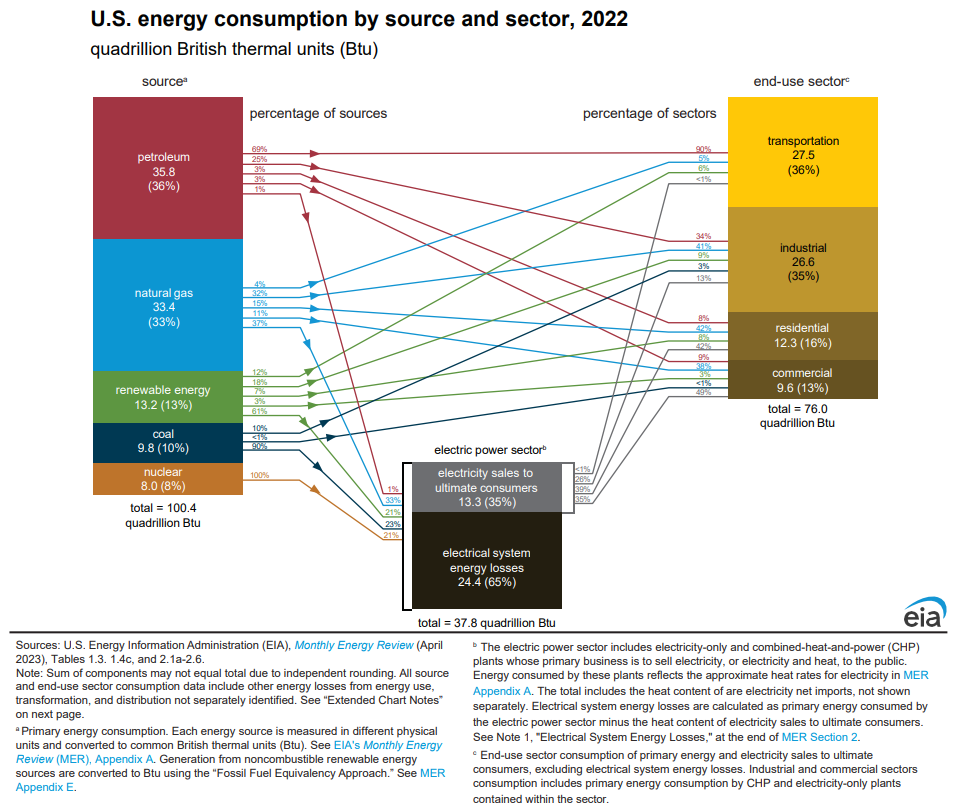
This post is only about electricity, which is 18% of US final energy. Fossil fuels overwhelmingly dominate the remaining 82%, where BAAJA would also have uncertain, but likely extensive, impacts.
MISO background
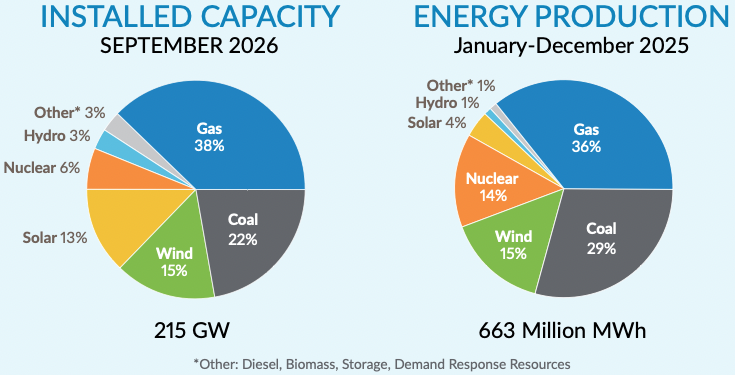
According to their September fact sheet, MISO has 217 GW of installed capacity, 60% of it fossil fueled. In 2025, MISO’s existing fleet of power plants generated 663 TWh of electrical energy, 65% from fossil fuels (36% gas, 29% coal), for an annual average power output of 76 GW and a fleet capacity factor of 35%. (A capacity factor is a ratio of annual average power output to installed capacity.)
MISO reviews interconnection requests in most years through their Definitive Planning Phase (DPP) process. MISO skipped DPP in 2024 to overhaul the process, remove speculative projects, and work through a big backlog. MISO’s 2026 process is still underway; preliminary results exist, but unfortunately still contain too many incomplete and potentially duplicative projects to be trustworthy, in my assessment. For these reasons, I’ll focus here on the 2025 DPP projects in MISO’s interconnection queue1.
MISO’s updated interconnection queue
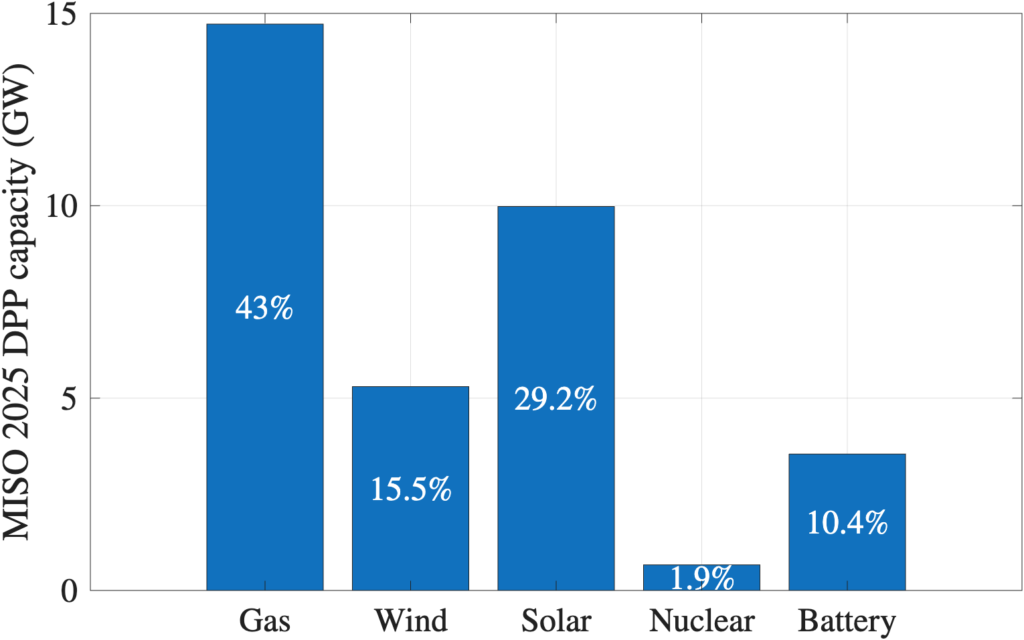
MISO’s 2025 queue contains 34 GW of total capacity. By total capacity (including batteries), it’s 43% gas. By generation capacity (excluding batteries), it’s 48% gas. For comparison, MISO’s 2023 queue – the last year before their DPP process update – was 8% gas by total capacity and 10% gas by generation capacity.
Capacity is just a technical capability: How much electric power a plant can generate if it runs all-out. Most of the things we care about – such as public health and mortality impacts from local pollution, climate change from greenhouse gas pollution, and profits from plant operation – depend not on capacity, but on how much energy a plant actually generates. Energy generation depends on how often and how hard a plant runs. It can be estimated as the product of capacity, capacity factor, and the number of hours in one year (8,760).
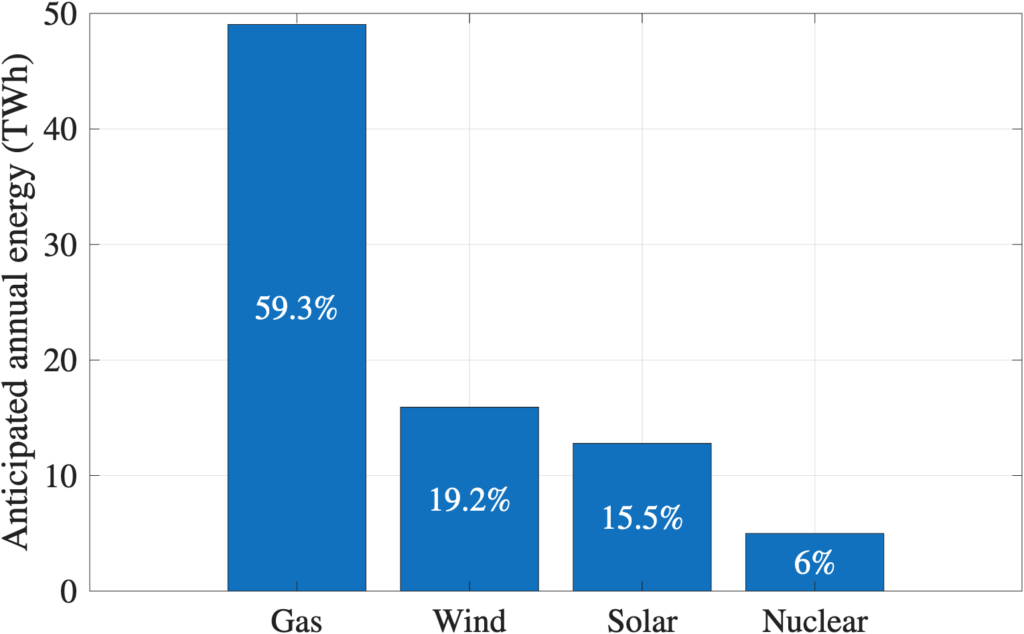
By anticipated annual energy output, MISO’s 2025 queue is 59% gas, 19% wind, 16% solar, and 6% nuclear.
To calculate these estimates, I used MISO’s 2025 capacity factors for wind (34.3%), solar (14.6%)2, and nuclear (85.3%) from their 2025 and 2026 fact sheets. I couldn’t find 2025 MISO-specific energy generation or capacity factor data for combined-cycle vs. simple-cycle gas plants, so I used the 2025 US average capacity factors of 58.4% and 17.1%3.
Simple-cycle plants make up half of MISO’s 2025 queued gas capacity. They’re cheaper to build than combined-cycle plants, but less efficient, so they pollute more and cost more to run. Historically, simple-cycle plants usually ran at low capacity factors, mainly to help meet demand peaks. In the brave new world of AI data centers, however, simple-cycle plants are running at higher capacity factors. If the simple-cycle plants in MISO’s 2025 queue ran at the same fleet-average 58.4% capacity factor as combined-cycle plants, the gas share of MISO’s queued energy generation would rise to 69%.
Whether it’s 59%, 69%, or somewhere in between, the gas share of MISO’s 2025 queue is comparable to the 65% fossil share of the total electricity generated by MISO’s existing fleet in 2025. If BAAJA equally accelerated buildout of all generator types in MISO’s queue, I’d expect the fossil share of MISO’s annual energy generation to stay about the same.
If BAAJA also increased MISO’s annual energy demand, for example by accelerating data center interconnection, then I’d expect the public health and mortality impacts related to MISO’s fossil generator fleet, as well as its greenhouse gas emissions, to get worse.
MISO’s interconnection fast track
MISO’s Expedited Resource Addition Study (ERAS) process, a fast track for generator interconnection review, aims to address pressing reliability and resource adequacy challenges related to rapid load growth, for example from AI data centers. Alongside MISO’s updated interconnection queue, the ERAS results provide another leading indicator of the types of power plants people are trying to build.
MISO concluded its fifth ERAS cycle in September. The fast-tracked capacity additions are 54% gas by total capacity, 84% gas by generation capacity, and 93% gas by anticipated annual energy generation.
- I obtained the 2025 DPP data by setting Status to Active in MISO’s queue dashboard, setting Fuel Type and State to All, searching for DPP-2025, and clicking Download Filtered View. Here‘s a copy of the CSV output. ↩︎
- MISO’s 14.3% solar capacity factor may seem low to energy professionals who work in solar hot spots such as California, Arizona, or Texas. For comparison, the 2025 US average capacity factor for solar photovoltaics was 24.4%. I believe the lower MISO value is due mainly to geography and weather patterns: MISO territory runs as far north as Minnesota, where annual insolation is low, and many member states are fairly cloudy. ↩︎
- 17.1% is the direct average of the three non-combined-cycle gas plant types in the EIA data: gas turbine (14.1%), steam turbine (19.8%), and internal combustion (17.4%). ↩︎