This is the fourth live-blog of my spring 2026 DERs class.
I think there are three main reasons to study Distributed Energy Resources (DERs): Health, money, and climate. The last post focused on health. This post will focus on money.
DERs present vast business opportunities. Worldwide, people pay other people some $10 trillion for energy each year. That’s about 9% of global annual GDP1. About 80% of energy expenditures are for fossil fuels. DERs alone won’t displace all of that fossil fuel use, but displacing even a modest 15% is a trillion-dollar-per-year opportunity.
DERs are already economically attractive in many settings and are getting more attractive each year. Lithium ion battery prices, for example, fell by 86% from 2013 to 2024. Solar photovoltaic panel prices2 fell by 87% from 2011 to 2024. Solar panels now cost less per unit area than siding, roofing shingles, or fence pickets. These price declines are examples of the “learning by doing” effect: For many clean energy technologies, prices drop by 10-20% with each doubling of manufacturing capacity. Manufacturing capacity for many DERs has doubled many times in the last decade, driven overwhelmingly by China.
Due in part to these price declines, adoption of clean energy technologies is accelerating. US battery capacity installations reached 11 GW in 2024, up from 0.25 GW in 2019 (4,400% growth in five years). Electric vehicles reached 7% of US vehicle sales in 2023, up from 2% in 2019 (350% growth in five years). Solar photovoltaics reached 67% of US electricity generation capacity installations in 2024, up from 34% in 2019 (197% growth in five years). Electric heat pump sales outpaced natural gas furnaces in 2022 at 4.3 million units, up from 2.6 million in 2017 (165% growth in five years). These growth rates are unheard-of in most industries.
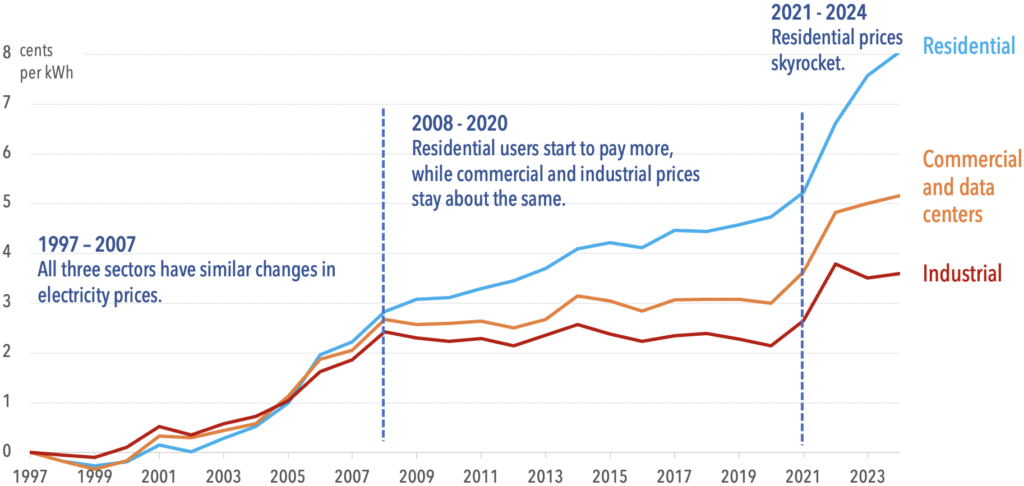
DERs can make life more affordable. The graph below, made by Karin Kirk at Yale Climate Connections, shows the rise in retail electricity prices since 1997 by year and by economic sector. Residential electricity prices have risen sharply since 2021, both in absolute terms and compared to commercial and industrial electricity prices.
DERs can lower electricity bills in two ways. First, households can generate electricity locally with solar, use electricity more efficiently with modern appliances, and shift electricity demand to low-price times with batteries and demand flexibility. Second, DERs can reshape electricity demand profiles to alleviate strain on wires, transformers, and other distribution grid infrastructure. This can avoid expensive infrastructure buildout, the costs of which utilities pass on to all ratepayers by raising prices.
DERs can reduce economic inequality. Almost everyone spends money on fossil fuels, but almost all of that money goes to a small number of fossil-fuel company owners, executives, and major shareholders. In the US, for example, the richest 1% own 50% of all corporate equities and mutual fund shares; the next-richest 9% own another 37%. The other 90% of Americans own just 13%. DERs, by contrast, are usually owned by the people whose roofs, basements, and garages the DERs occupy. In a DER-rich future, almost everyone would reap the benefits of their own energy infrastructure.
That’s my take on money and DERs: DERs present vast and growing business opportunities. DERs can also make energy more affordable, both for DER owners and for everyone who pays utility bills, while reducing economic inequality.
- While GDP is a widely used economic measure, it’s worth remembering that it’s a pretty bad one. GDP ignores inequality: If I make $50 trillion and the other 350 million Americans all lose $100,000, then US GDP goes up by $15 trillion. GDP ignores unpaid work: If 50 million Americans each spend 1,000 hours per year on care work and housework, then those 50 billion person-hours — worth $1 trillion if valued at $20 per hour — generate $0 in GDP. GDP rewards bad stuff: If my power plant gives you lung cancer that you spend $100,000 to treat, then GDP goes up by $100,000.
- These price declines are for the panels themselves, the physical rectangles. Total installed costs have fallen too, but not as steeply due to “soft costs” such as marketing, sales, permitting, installation labor, and installer profit. Some countries are better than others at reducing soft costs.