This is the fifth live-blog of my spring 2026 DERs class.
I think there are three main reasons to study Distributed Energy Resources (DERs): Health, money, and climate. The last two posts focused on health and money. This post will focus on climate.
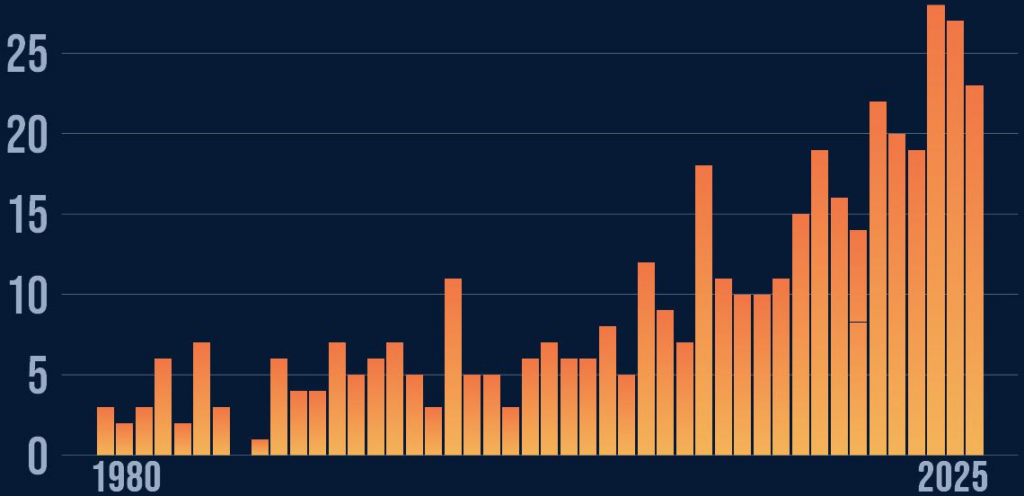
Humans have changed the climate. The US, for example, is seeing increasingly frequent and severe droughts, floods, wildfires, extreme storms, and other weather and climate disasters. The graph below shows that the number of billion-dollar weather and climate disasters (inflation-adjusted to 2025 dollars) per year has risen steadily since 2005. Over the last ten years, US billion-dollar weather and climate disasters have cost $1.5 trillion and killed 6,500 people. Recent advances in attribution science show that climate change is contributing to the increasing frequency and severity of these disasters.
Due in large part to recent advances in clean energy technologies and costs, a parallel two-path strategy based on existing, economically competitive technologies can now reduce global climate pollution by two-thirds or more. The first path is to clean up the power grid by replacing fossil-fueled power plants with clean generation (~25% of US climate pollution). The second, parallel path is to switch heating (~25%) and driving (~16%) from fossil fuels to electricity.
DERs feature prominently in that two-path strategy. As the last post discussed, solar photovoltaics are now the fastest-growing electricity source. Distributed solar economics only get better as utilities raise retail electricity prices. Electric heat pumps can replace fossil fuels for space heating, water heating, and low- and medium-temperature industrial processes. Electric resistance heat and thermal storage can replace fossil fuels for many high-temperature industrial processes. Electric skateboards, bikes, wheelchairs, scooters, buses, trains, cars, and trucks can replace light- and medium-duty fossil-fueled vehicles.
Cleaning up the grid and electrifying everything we can won’t eliminate all climate pollution. We need to work in parallel on reducing energy demand, on agriculture, on deforestation, on many other things.
But there’s a whole lot of proven, cost-effective action we can take today. DERs feature prominently in that action and bring additional health and affordability benefits.