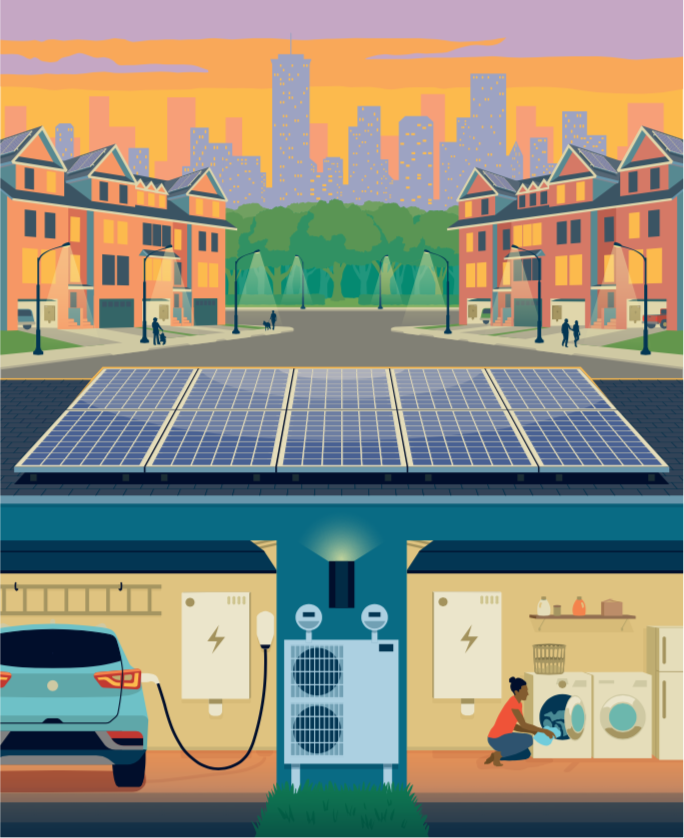
Distributed energy resources (DERs) are controllable electrical devices that plug in at the edge of the power grid, typically through buildings. DERs — such as electric vehicles, heating and cooling equipment, energy storage systems, and rooftop solar photovoltaics — will play an increasingly important role in future energy systems that decarbonize, digitalize, and decentralize their operations. In this class, students will learn to model a variety of DERs, optimize DER designs, and control DERs to reduce costs, pollution, and impacts on the power grid. This class will involve a mix of coding and mathematical analysis. Students will do semester projects on current DER topics.
Flyer
Syllabus
Schedule
Discord
Lecture slides
- Introduction
- Energy, electricity, and DERs
- Linear ordinary differential equations (with blanks unfilled / filled)
- Linear dynamical systems
- Batteries and electric vehicles (with blanks unfilled / filled)
- Solar energy (with blanks unfilled / filled)
- Buildings, part 1
- Buildings, part 2
- Heating, ventilation, and air conditioning (with blanks unfilled / filled)
- Thermal storage and water heaters (with blanks unfilled / filled)
- Modeling summary
- Optimization overview (with blanks unfilled / filled)
- Regression
- Convex sets and functions (with blanks unfilled / filled)
- Solving convex optimization problems (with blanks unfilled / filled)
- DER objectives
- Battery examples
Lecture videos
Please see Brightspace for this semester’s videos.
Blog
- Introduction
- What are DERs?
- Why DERs? (Health, money, climate)
- Modeling DERs
- More battery modeling
- A miasma of incandescent plasma
- Buildings and thermal equipment
- Thermal modeling for buildings
Homework
- ODEs and dynamical systems
- Batteries and electric vehicles
- Solar energy
- Buildings
- HVAC and thermal storage
- Optimization
Code
- Simple climate model (linearization, time discretization)
- Electric vehicles (dynamics, charging policies)
- Solar energy (solar angles, surface irradiance, net metering)
- Buildings (thermal dynamics, heating/cooling policies)
- Water heaters (dynamics, charging policies)
- Optimization (gradient descent, line search)
- LaTeX introduction (equations, sketches, figures, tables)
Midterm exam scheduling poll
Read, listen, watch
- Lorenzo Kristov, Paul De Martini, and Jeffrey Taft: A tale of two visions: Designing a decentralized transactive electric system. IEEE Power and Energy Magazine, 2016
- David Roberts: Clean energy technologies threaten to overwhelm the grid. Here’s how it can adapt. Vox, 2018
- David Roberts and Lorenzo Kristov: Envisioning a more democratic, bottom-up energy system. Volts, 2024
- Wikipedia: Ohio nuclear bribery scandal
- 3Brown1Blue: How (and why) to raise e to the power of a matrix
- NY Times: Tens of thousands in Tennessee, Mississippi and Louisiana without power after storm
- Carbon Brief: Clean energy drove more than a third of China’s GDP growth in 2025
- Indiana Economic Digest: Under House Bill 1333, Indiana opens door to more development in rural areas without public input
- Canary Media: California’s rooftop solar debate is raging again
- PV Magazine: World’s largest steam-producing heat pump comes online in Finland
- Drilled Media/Klimakulture: The Black Thread
- European Network of Transmission System Operators for Electricity: Final report on the 28 April 2025 Spain/Portugal blackout
- Jennifer Downing et al.: Pathways to commercial liftoff – Virtual power plants. US Department of Energy Loan Programs Office, 2023, pages 1-55.
- Sonali Razdan et al.: Pathways to commercial liftoff – Virtual power plants, 2025 update. US Department of Energy Loan Programs Office, 2025, pages 2-15.